 Save
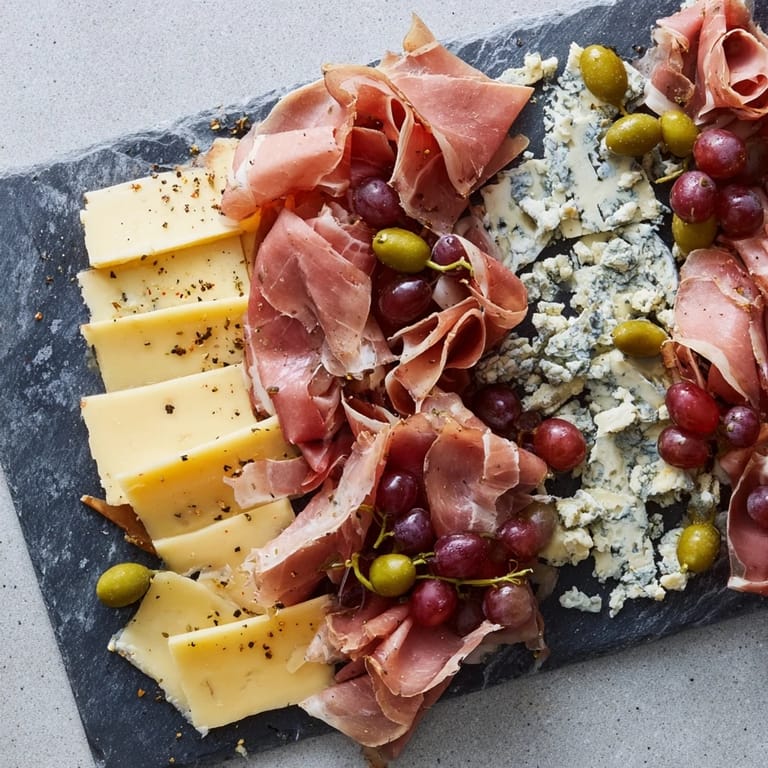
Save There's something about a slate board that makes you want to pause and appreciate what's on it. I discovered this when a friend handed me a heavy, unpolished stone slab at a dinner party and asked me to arrange some meats and cheeses on it—no fussy patterns, just clean lines and honest ingredients. The minimalist arrangement felt almost architectural, and watching guests lean in to admire it before eating became the best part of the evening. That moment taught me that sometimes the most impressive dishes are the ones that let quality ingredients speak for themselves.
I made this for my sister's book club once, and what I remember most isn't the compliments on the platter—it was someone saying, "This is what confidence looks like on a board." She meant it as a joke, but it stuck with me. There's real power in knowing your ingredients are good enough that they don't need hiding under sauces or complicated technique. The straightforward lines, the unpolished stone, the bold flavors—it all felt like telling the truth.
Ingredients
- Smoked prosciutto: Buy it sliced thin from a good counter; it's delicate enough to drape lightly and strong enough to anchor the whole board with its salty, smoky edge.
- Soppressata: This Italian cured meat has a tighter grain than other salamis, so it slices clean and doesn't crumble—precision matters when you're working in straight lines.
- Coppa: Fattier than soppressata, it brings richness and a subtle sweetness that balances the sharp cheeses perfectly.
- Mortadella: The silky texture and hidden pockets of fat make it the luxurious player here; slice it thick enough to hold its shape but thin enough to taste delicate.
- Aged cheddar: Hunt for something with a few years on it—the crumbly crystals and deep flavor stand up to the salty meats without disappearing.
- Manchego: Its nutty, slightly salty character bridges the gap between the meat and blue cheese, preventing any one flavor from dominating.
- Gruyère: The umami depth and melting texture create a contrast you won't expect but will crave once you taste it alongside the others.
- Blue cheese: Use this sparingly as an accent; its intensity is intentional, not a mistake—a little goes a long way to keep things interesting.
- Seedless red grapes: They're your palate cleanser and visual relief from the richness, and their slight acidity cuts through the fat beautifully.
- Cornichons: These tiny pickles are sharper than regular dill pickles and add brightness without overwhelming; keep them chilled right up to serving.
- Whole grain mustard: The texture and mild heat complement the cured meats without stealing focus from the board itself.
- Mixed olives: Choose briny ones, not oil-cured; they need to taste like the sea, not like they've been sitting in a jar for months.
- Freshly cracked black pepper: Grind it just before serving so the aromatics are still alive and you get those little bursts of heat.
Tired of Takeout? 🥡
Get 10 meals you can make faster than delivery arrives. Seriously.
One email. No spam. Unsubscribe anytime.
Instructions
- Set your foundation:
- Place your slate board on the table where it'll stay—moving it once everything is arranged will shift all those careful lines. Run your fingers across it to check for any rough spots or moisture that might make things slide.
- Create the first line:
- Start with one cold meat, arranging it in a clean, parallel line down one third of the board. The repetition of thin slices creates rhythm, and you'll start to see why this geometry matters.
- Build your layers:
- Add each remaining meat in its own line, keeping the same spacing and angle. You're not being fussy—you're creating visual balance that makes people want to reach for something.
- Mirror with cheese:
- On the opposite side, arrange your cheeses in the same linear pattern, creating a visual conversation between the two sides. Vary the thickness so you see different textures and colors.
- Fill the gaps:
- Tuck small clusters of grapes, cornichons, and olives into the spaces between the meats and cheeses. Think of them as punctuation marks that break up the straight lines and add life to the composition.
- Add the condiments:
- Spoon whole grain mustard in a thin line, or keep it in a small dish at a corner where it won't drip. This is your final note of brightness and practicality.
- Finish with pepper:
- Just before serving, crack fresh pepper over the meats and cheeses—not the board itself, just the proteins. The aroma hits first and signals that this is food meant to be eaten right now.
- Present with confidence:
- Step back and look at it, then bring it straight to the table. The moment of quiet appreciation before people start eating is half the point.
 Save
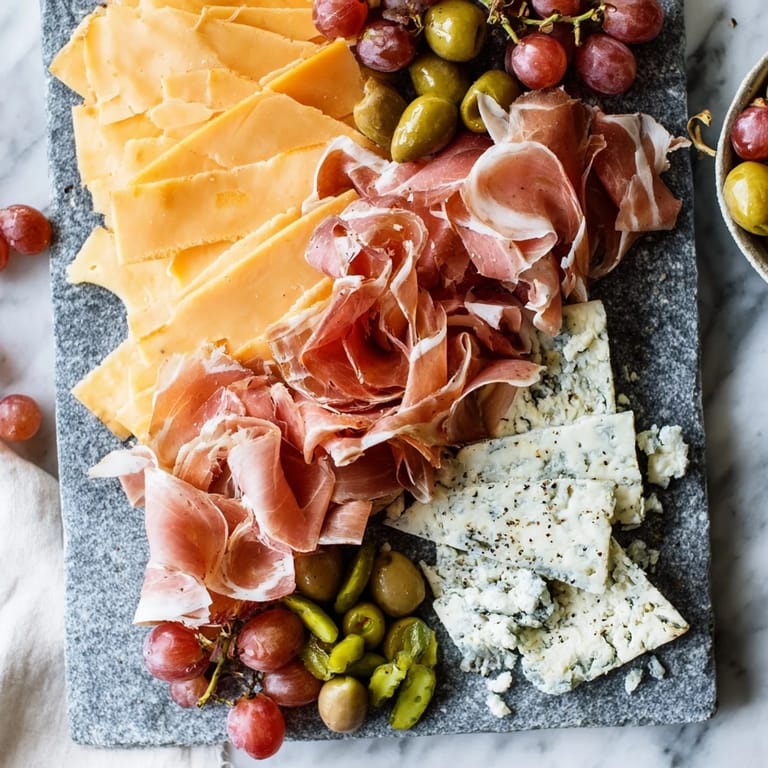
Save I once had someone ask me, "Why is this nicer than just putting everything in a bowl?" and I didn't have a fancy answer—I just said, "Because now you have to look at it before you eat it." That pause changed how they experienced the flavors. Sometimes slowing people down is the kindest thing you can do.
Choosing Your Slate
The board is as much an ingredient as the food itself. Hunt for something heavy, unpolished, and at least sixteen inches across—a light slate will feel cheap, and a small one defeats the whole modern aesthetic. I found mine at a restaurant supply store, and it's weathered now from regular use, which somehow makes it look better. The slight variations in color and texture are features, not flaws; they give the straight lines of food more visual interest. If you can't find slate, salvaged stone or dark wood works, but avoid anything too smooth or too pristine—the whole point is that honest, industrial feel.
Timing and Temperature
This is not a dish you can assemble an hour early and hope it stays perfect. The meats begin to dry out, the cheese sweats, and you lose that crisp, just-arranged energy that makes it feel special. I've learned to prep everything—slice and arrange it all—then cover it lightly with plastic wrap in the fridge until thirty minutes before guests arrive. Then you unwrap, do a final arrangement in five minutes, and everything tastes and looks the way you intended. The grapes get slightly soft if they've been sitting in the cold too long, so add those last, just as people are walking in.
Pairing and Serving
Serve this with wines that match the boldness on the board—a crisp Sauvignon Blanc cuts through the richness, or go the other direction with a structured Cabernet that stands up to the aged cheddar and blue cheese. A dry rosé is underrated here too; it bridges the gap between the two. I've found that people eat differently when food is this beautiful and self-contained—they graze, they pause between bites, they talk more. You're not just feeding them; you're creating a moment.
- Keep the board on the table for the whole gathering so people can return to it without asking.
- Provide small plates and cocktail napkins—this is finger food, but people like to feel slightly composed.
- If you're short on space, you can build the platter on a large dark wooden board instead of slate and achieve a similar effect.
 Save
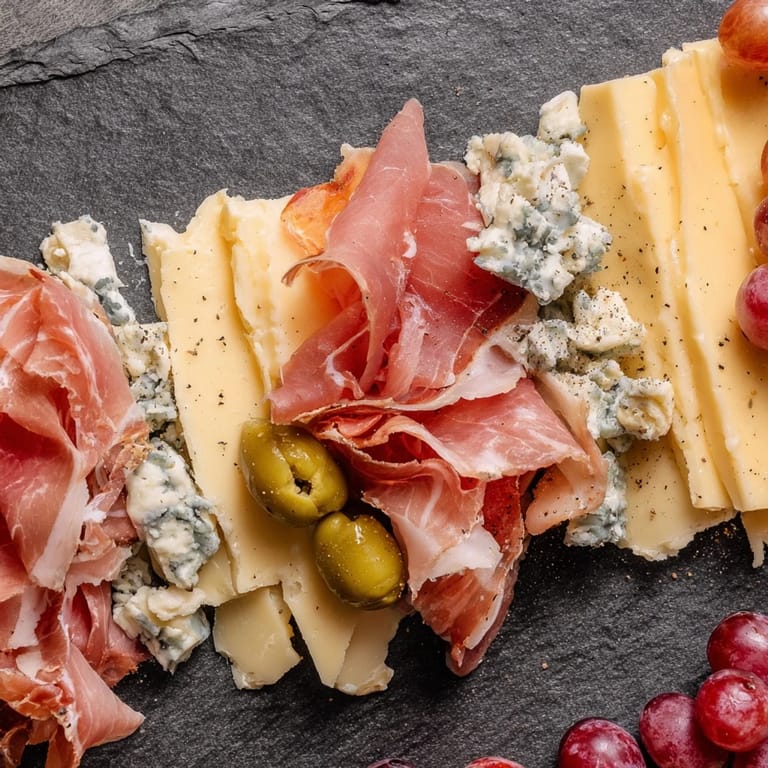
Save This platter taught me that sometimes the most memorable meals aren't the complicated ones. They're the ones where everything tastes good, looks honest, and lets people relax into the moment.
Recipe Questions & Answers
- → What types of meats are used in this platter?
Smoked prosciutto, soppressata, coppa, and mortadella are arranged to provide a rich variety of flavors and textures.
- → Which cheeses complement the cold meats here?
Sharp cheeses like aged cheddar, Manchego, Gruyère, and blue cheese create a balanced contrast with the meats.
- → How should the ingredients be arranged for serving?
Place the meats and cheeses in straight, parallel lines on opposite sides of a sturdy stone or slate board, filling gaps with grapes, olives, and cornichons.
- → Can this dish be adapted for vegetarians?
Yes, simply omit the meats and substitute with marinated artichoke hearts and roasted nuts to maintain variety and texture.
- → What beverages pair well with this platter?
Crisp dry white wines like Sauvignon Blanc and bold reds such as Cabernet Sauvignon enhance the flavors beautifully.